
Last checked: October 22, 2026
Most online sellers end up paying for several ecommerce research tools: one for keywords, one for competitors, one for ads, one for analytics, and often a freelancer for content. An AI agent such as StoreClaw offers a different approach, with one workspace that reads your store data and handles many of those jobs. This guide compares the two honestly, so you can decide whether to switch, keep what you have, or mix both.
What a typical tool stack looks like
A seller running Amazon or Shopify often uses some mix of:
- Analytics and spreadsheets to track sales, stock and margins.
- A keyword or SEO tool for search terms and ranking checks.
- Ad dashboards for each channel.
- A competitor or price tracker.
- A writing tool or freelancer for listings and product pages.
- A scheduler for social posts.
Each tool does its job well, but the work between them is manual. You export data, compare it in a sheet and decide what to do.
What a single AI agent offers
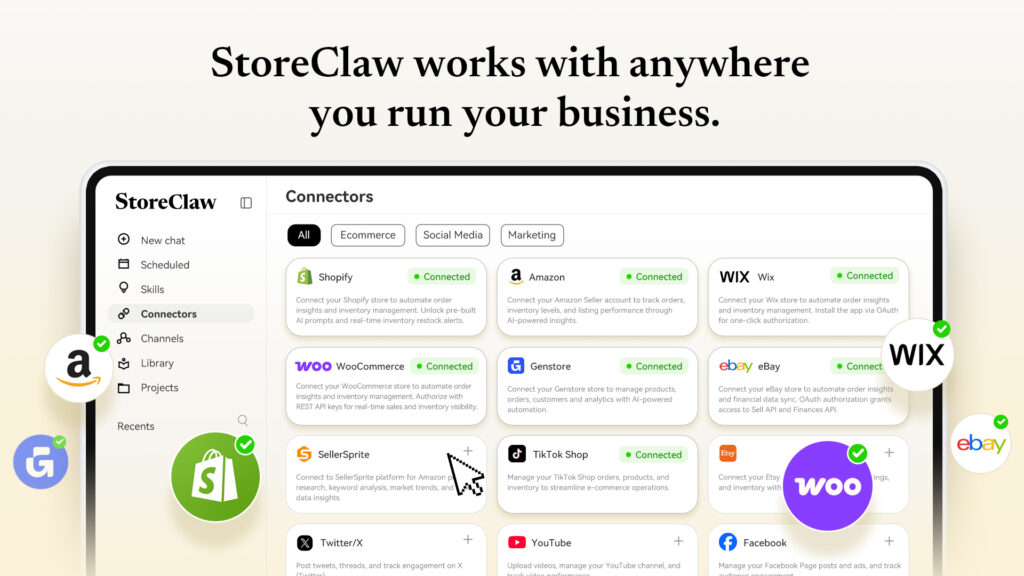
StoreClaw describes itself as an AI agent for online sellers. According to its materials, it is organised into four modules: store diagnostics, traffic growth, product launch and social content. It connects to platforms such as Shopify, Amazon, WooCommerce, eBay and TikTok Shop, and lists dozens of ready-made AI skills. The idea is that one tool reads your sales, stock, ads and traffic, flags problems, and drafts fixes you approve. Our StoreClaw review covers what we could and could not verify.
Side-by-side comparison
| Separate tool stack | One AI agent (StoreClaw) | |
|---|---|---|
| Setup | Several accounts and logins | One workspace, connectors per store |
| Data in one place | Manual exports | Connected stores and ad accounts |
| Depth in one area | Often deeper, such as dedicated keyword databases | Broader, may be shallower per task |
| Routine checks | You run them | Can run on a schedule |
| Changes to your store | You make them | Proposed for your approval |
| Cost | Several subscriptions | One plan, with credits |
| Risk | Missed problems between tools | Reliance on one vendor |
Compare the cost
Add up what you pay each month for the tools and freelance help you would replace. Then compare it with StoreClaw's plans, last confirmed on October 4, 2026:
| Plan | Price per month | Credits per month |
|---|---|---|
| Free | $0 | 300 on signup, 50 daily refresh credits |
| Pro | $19.90 | 6,000 |
| Max | $39.90 | 12,000 |
| Ultra | $199.90 | 60,000 |
Credits are used up by tasks, and we do not have verified figures for the credit cost of each task. The free plan is the safest way to measure how fast you would use them. Yearly billing is shown as 20% off. Our guide to StoreClaw discounts for Shopify and Amazon sellers explains the current offers.
When a separate tool is still better
- You need deep keyword research or large historical datasets.
- You rely on a specialist feature that an all-in-one agent may not match.
- You work in a niche platform the agent does not connect to.
- You have an established workflow that already works.
When one agent makes sense
- You spend hours each week switching between dashboards.
- You are a small team without a dedicated analyst.
- You want regular health checks without building them yourself.
- You are comfortable approving proposed changes rather than making each one.
A low-risk way to decide
1. List the five jobs you spend the most time on each week. 2. Connect one store to the free plan. 3. Run those jobs through the agent for two to four weeks. 4. Compare its findings with your current tools. 5. Cancel a tool only after the agent has matched it on real data.
For a routine to start with, see our Shopify store health check guide or, if you sell on Amazon, our Amazon seller AI tool walkthrough.
Frequently asked questions
What are ecommerce research tools? They are tools that help you find products, keywords, competitors and market data, such as keyword tools, trend trackers and competitor monitors.
Can one AI agent replace all my tools? Rarely all of them. It may replace routine checks and drafting, while specialist tools can still be better for depth.
Is StoreClaw cheaper than a tool stack? It depends on what you pay now and how many credits you use. Test the free plan to find out.
What should I check before switching? Compare its results with your current tools on your own data, and confirm what it can access and change.
