Press Enter to search reviews, tools & deals
We tested 20+ platforms so you don’t have to. Here’s the definitive, no-fluff guide to the best AI tools for business automation that actually deliver ROI — with real pricing, honest pros & cons, and a step-by-step buying framework.
The best AI tools for business automation are platforms that go beyond simple rule-based triggers to offer intelligent, context-aware workflow execution. If you’re searching for the best AI tools for business automation, you’re looking for solutions that can read unstructured data — like emails, PDFs, and chat messages — and make decisions autonomously based on that context, without requiring manual intervention at every step. The best AI tools for business automation save teams hundreds of hours monthly while eliminating human error across every department.
Unlike traditional automation that requires exact, pre-programmed conditions, the best AI tools for business automation in 2026 can understand intent, adapt to changing inputs in real time, and execute multi-step processes that previously required human judgment. This is why companies of every size are rapidly adopting the best AI tools for business automation: the ROI is measurable, the setup time has never been shorter, and the cost has dropped to a level accessible even for solo founders.
The best AI tools for business automation landscape in 2026 spans four key categories: no-code platforms for non-technical teams, low-code solutions for teams with some technical knowledge, code-first tools for developers who demand full control, and AI-native platforms that use large language models as the core decision engine — making them fundamentally more capable than any previous generation. Whether you run a startup or a multinational, the best AI tools for business automation give your team a compounding productivity advantage that grows over time.
This guide to the best AI tools for business automation is designed for every type of buyer. The best AI tools for business automation serve different needs at different company sizes — from solo founders who need a free, fast-to-setup platform to enterprise directors who need SOC 2 compliance and desktop RPA. Whether you’re a complete beginner or a technical power user, our hands-on reviews of the best AI tools for business automation are structured to match your exact situation, technical level, and budget.
Maximum automation impact, minimum budget. We highlight the best free tiers and affordable entry points for AI business automation that deliver real ROI from day one.
You need AI automation tools that scale with you — without creating technical debt or requiring a full IT department to manage.
Security, compliance, and deep integrations with your existing enterprise tech stack are non-negotiable. We cover the best AI automation tools that meet enterprise demands.
You want API access, self-hosting options, and custom integration capabilities. We’ve included developer-first AI business automation tools built specifically for you.
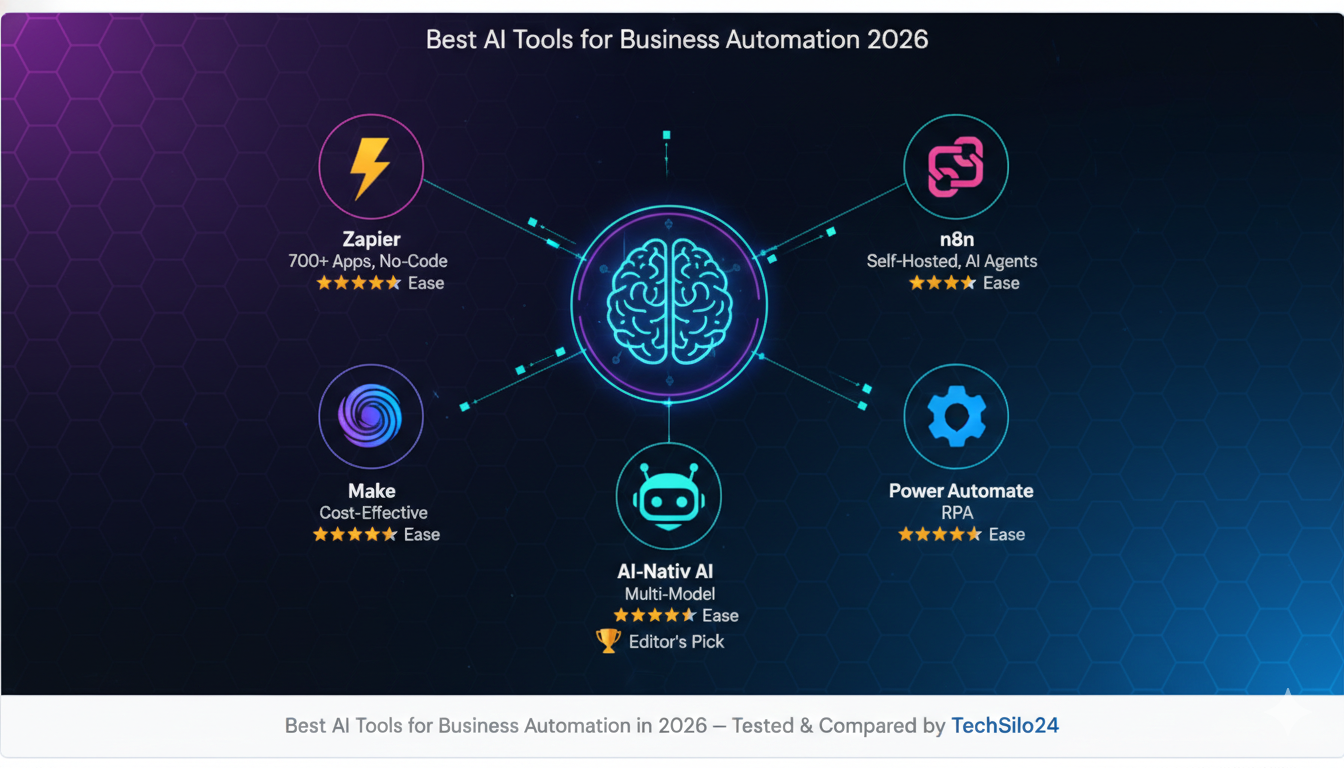
The comparison table below gives you a fast, side-by-side look at the five best AI tools for business automation we’ve reviewed in depth. When comparing the best AI tools for business automation, the key variables are starting price, free plan availability, ease of use, and how deeply AI is embedded in the platform. Use this table to quickly identify which of the best AI tools for business automation matches your budget, technical level, and primary use case before diving into the full reviews.
| Tool | Best For | Starting Price | Free Plan | Ease of Use | AI Depth | Score |
|---|---|---|---|---|---|---|
| Zapier Most Popular | No-code, SMB | $29/mo | ✓ Yes | ⭐⭐⭐⭐⭐ | Medium | 9.2/10 |
| Make | Visual workflows, agencies | $9/mo | ✓ Yes | ⭐⭐⭐⭐ | Medium-High | 8.9/10 |
| n8n Open Source | Developers, self-hosted | Free / $24/mo | ✓ Self-hosted | ⭐⭐⭐ | High | 8.7/10 |
| Power Automate | Microsoft 365 enterprise | $15/user/mo | ✗ No | ⭐⭐⭐⭐ | High | 8.5/10 |
| Lindy AI Editor’s Pick | AI-native agents, smart automation | $49/mo | ✓ Yes | ⭐⭐⭐⭐⭐ | Very High | 9.4/10 |
*Prices verified February 2026. Always confirm current pricing on each tool’s official website.
Below are our hands-on reviews of the five best AI tools for business automation. Evaluating the best AI tools for business automation requires testing them on real workflows — not just reading spec sheets. We tested each of these best AI tools for business automation across CRM updates, email triage, document processing, and multi-step data pipelines — to give you an accurate, practical picture of what each of these AI business automation tools can actually deliver for your team day-to-day.
When people search for the best AI tools for business automation, Zapier is almost always the first platform they encounter — and for very good reason. With over 7,000 app integrations (the largest library of any automation platform), Zapier can connect virtually every software tool your business uses, making it the most versatile starting point for companies looking to adopt AI business automation without technical complexity.
In 2026, Zapier significantly deepened its position among the best AI tools for business automation by introducing AI Steps — the ability to inject AI reasoning at any point inside a workflow. You can now classify incoming data, generate personalized responses, make routing decisions, or summarize documents, all without leaving the Zap builder. This single feature dramatically expands what non-technical users can accomplish with AI business automation. For example, we built an email-to-CRM pipeline with AI-powered lead scoring in under 45 minutes — something that previously required custom code.
The key trade-off with Zapier as an AI business automation platform is its task-based pricing model. At higher volumes, costs escalate faster than most users expect, especially when running multi-step Zaps that consume multiple tasks per automation run. For businesses with high-volume needs, Make or n8n offer better economics. But for straightforward AI business automation needs with predictable volumes, Zapier remains the best starting point in 2026.
Make (formerly Integromat) is consistently ranked among the best AI tools for business automation because it delivers power-user-level flexibility at a price point that’s dramatically lower than Zapier. Its canvas-based, node-style scenario builder gives you a visual map of exactly how data flows through your AI business automation — making it significantly easier to build, debug, and maintain complex workflows compared to Zapier’s linear interface.
Make’s operation-based pricing model consistently makes it 60–80% cheaper than Zapier for high-volume AI business automation. For agencies managing multiple client automation workflows, this pricing difference alone can justify the switch. Make also integrates natively with OpenAI, Claude, and Gemini models — letting you add AI-powered text processing, content generation, and intelligent routing anywhere in your business automation workflow. See our full Zapier vs Make comparison for a detailed breakdown.
The primary trade-off when choosing Make as your AI business automation platform is a steeper learning curve than Zapier. The visual canvas, while powerful, can feel overwhelming for users who have never worked with workflow automation tools. If your team is completely non-technical, Zapier or Lindy AI may be more comfortable starting points. But Make is unquestionably one of the best AI tools for business automation for anyone willing to invest a few hours learning the interface.
n8n has rapidly become one of the most talked-about AI tools for business automation in developer communities worldwide, and its rise is entirely justified. It is completely free to self-host, meaning businesses with their own infrastructure can run sophisticated AI business automation workflows at essentially zero software licensing cost. Enterprises including Vodafone, Zendesk, and Wayfair rely on n8n in production — which demonstrates that “open source” and “enterprise-grade” are not mutually exclusive when it comes to AI business automation.
What sets n8n apart from other AI tools for business automation is its native LangChain integration and built-in AI Agent framework. You can construct autonomous AI agents with memory, tool use, and multi-step reasoning directly inside the visual workflow editor — without needing to write Python or JavaScript from scratch. For technical teams building sophisticated AI business automation (for example, an agent that researches leads, drafts and sends personalized emails, then updates your CRM automatically), n8n is the most capable open-source option available. Read more in our guide to the best no-code automation tools for context on where n8n fits in the landscape.
The free self-hosted version of n8n is an extraordinary value for technical AI business automation teams. However, “free” comes with the responsibility of managing your own server infrastructure, performing updates, and handling backups. n8n’s cloud offering starts at $24/month for teams that want the power of n8n without the infrastructure overhead — still significantly cheaper than most competing AI automation platforms.
For organizations running on Microsoft 365, Power Automate is the most natural and most deeply integrated AI tool for business automation available — and it may already be included in your current subscription. It connects natively with Teams, SharePoint, Outlook, Excel, Dynamics 365, and Azure at a depth that third-party AI business automation tools like Zapier and Make simply cannot replicate, enabling automation scenarios that leverage Microsoft’s entire platform ecosystem.
Microsoft Copilot’s integration into Power Automate has been one of the most significant developments in enterprise AI business automation in 2026. You can now describe a business workflow in plain English and have Copilot generate the complete automation structure for you — dramatically reducing the time from idea to live automation. AI Builder adds document intelligence capabilities to your AI business automation, automatically extracting data from invoices, contracts, and forms. The full Desktop RPA module enables automation of legacy desktop applications that have no API whatsoever. For more on how Power Automate compares to other enterprise options, see our AI tools for small business guide.
The primary limitation of Power Automate as an AI business automation tool is its reduced value outside the Microsoft ecosystem. Premium connectors for non-Microsoft apps can also add meaningful cost. But for Microsoft-centric organizations, Power Automate is unquestionably among the best AI tools for business automation at the enterprise level.
Lindy AI earns the top position in our review of the best AI tools for business automation in 2026 because it represents a genuinely new and more powerful paradigm for business automation: AI-agent-first automation. Rather than connecting apps through rigid trigger-action rules like other AI business automation tools, Lindy builds intelligent agents that understand the goal of a workflow, reason about how to achieve it, and execute multi-step processes autonomously — selecting the optimal AI model (Claude, GPT-4, or Gemini) for each specific task within the workflow.
When we tested Lindy as an AI tool for business automation, we built an email triage agent that categorized, prioritized, and drafted contextual responses to over 200 emails — and the entire setup took under 90 minutes. We also deployed a CRM enrichment agent that automatically researched inbound leads, filled in company data, and assigned lead scores with accuracy significantly higher than comparable Zapier workflows. This is what separates Lindy from other AI business automation tools: the intelligence is built in, not bolted on. For a full breakdown of how AI automation has changed, check our guide on the best AI tools of 2026.
The multi-model AI selection capability is a key differentiator that puts Lindy above most other AI tools for business automation. The platform intelligently routes each task in a workflow to the most appropriate AI model — using Claude for complex reasoning and analysis, GPT-4 for creative content generation, and faster models for simple classification — without requiring any manual configuration. The result is AI business automation that is simultaneously smarter, faster, and more cost-efficient at scale than any comparable platform we tested.
With so many options available, choosing the best AI tool for business automation for your specific situation can feel overwhelming. Use this practical six-step framework to make a confident, well-informed decision about which AI business automation platform is right for your team, budget, and use cases.
Don’t try to automate everything at once. Identify the single workflow consuming the most manual time. Customer replies, lead data entry, invoice processing, and meeting scheduling are the most common high-ROI starting points for AI business automation tools.
If your team has zero coding experience, choose Zapier or Lindy AI as your AI business automation tool. If you have a developer who values control, n8n is dramatically more powerful and cost-effective at scale.
The best AI tool for business automation integrates natively with what you already use. Microsoft 365 users should consider Power Automate first. Check integration lists carefully before committing to any AI business automation platform.
Model costs at 10x current task volume. Some AI business automation platforms scale gracefully; others become prohibitively expensive. Task-based (Zapier) and operation-based (Make) pricing models behave very differently at scale.
Every AI tool for business automation on this list has a free plan or trial. Build your most important workflow on 2–3 platforms before deciding. The AI business automation tool that works intuitively for your team will always outperform the one with the best spec sheet.
Choose an AI business automation platform with a clear enterprise upgrade path or self-hosting option so you’re not forced to migrate your entire automation stack when you outgrow your starter plan in 12–18 months.
After extensive hands-on testing of the best AI tools for business automation, here are our definitive recommendations by use case. These are the AI business automation tools that delivered the strongest results in each category during our testing — with no bias toward pricing or affiliate commission rates.
Regardless of which of the best AI tools for business automation you choose, the most important step is to begin. The best AI tools for business automation reward early adopters with compounding operational advantages that late-movers cannot easily replicate. Businesses that deploy the best AI tools for business automation today — even imperfectly — free up human capacity for the creative, strategic, and relationship-driven work that AI cannot replace. Start with one workflow, prove ROI, and expand your use of AI business automation tools systematically from there.
Try our top-rated AI business automation tools free — no credit card required. Most teams build their first working automation in under 20 minutes.
Try Lindy AI Free → Try Zapier Free →Here are answers to the most frequently asked questions about the best AI tools for business automation in 2026. These FAQs cover everything from pricing and technical requirements to security and ROI timelines — everything you need to make a confident decision about which of the best AI tools for business automation is right for your company.
Based on our hands-on testing, Lindy AI is the best overall AI tool for business automation in 2026, thanks to its intelligent multi-model AI agents, fast no-code setup, and consistently high-quality outputs. However, the best AI tool for business automation for your specific situation depends on your team’s technical level, budget, and existing software stack. Zapier is the best AI business automation tool for beginners, Make is the best value at scale, n8n is best for developers, and Power Automate is the best AI tool for business automation in Microsoft 365 environments. For a broader look at the market, see our master list of the best AI tools of 2026.
Traditional business automation tools follow rigid, pre-programmed rules and can only process structured data in exact conditions. The best AI tools for business automation can understand context, process unstructured data like emails and PDF documents, adapt to changing inputs in real time, and make intelligent decisions autonomously. Traditional automation routes emails with “invoice” in the subject to a folder; the best AI business automation reads the email, extracts the amount, cross-references your records, and drafts the appropriate reply — all without human involvement.
The best AI tools for business automation range from completely free (n8n self-hosted) to enterprise pricing in the thousands per month. Most small business AI automation needs are met with plans between $9/month (Make) and $49/month (Lindy AI). Zapier starts at $29/month. Microsoft Power Automate is $15/user/month and is often included in Microsoft 365 subscriptions. Always model your costs at your expected task volume — pricing models vary significantly across the best AI business automation tools on the market.
No — most of the best AI tools for business automation are designed specifically for non-technical users. Zapier, Make, and Lindy AI are all accessible through drag-and-drop or natural language interfaces with no coding required. n8n and Microsoft Power Automate have steeper learning curves but are still largely no-code. Technical users can unlock significantly more power across all of these AI business automation platforms through code nodes and direct API integrations.
Most businesses implementing the best AI tools for business automation see measurable ROI within 30–90 days. With no-code platforms like Zapier and Lindy AI, you can have a live AI business automation workflow running in under 30 minutes. The key is starting with your highest-impact, highest-volume manual workflow — typically customer communication, lead management, or invoice processing. Don’t try to automate everything at once; focus on one workflow, prove value, then expand your use of AI business automation tools systematically.
Security varies by platform. For maximum data privacy, n8n self-hosted processes all data on your own servers — making it the safest AI business automation tool for sensitive information. Zapier, Make, and Lindy AI all offer SOC 2 Type II certified infrastructure. Microsoft Power Automate provides the most comprehensive enterprise compliance suite including GDPR, HIPAA, and ISO 27001 certifications. Always review data residency options and data processing agreements before handling sensitive information with any AI business automation tool.